Archaeologic finds
Found under the brewery of Eugène Marres at Maastricht
during the renovations in the year 1894
Around 1894, the brewery of Eugène Marres greatly expanded around the Onze Lieve Vrouweplein in Maastricht. At the Havenstraat is built a new factory. At the Plein a new house is built at the place of two older ones.
New cellars were dug under the Havestraat and under the houses and gardens on both sides of the Plankstraat and the Stokstraat. There will be a new residential block of four floors for employees.
The brewery is located in the oldest part of the city of Maastricht, just outside the foundations of the former Roman castellum. During the renovation a lot of historical material comes upwards.
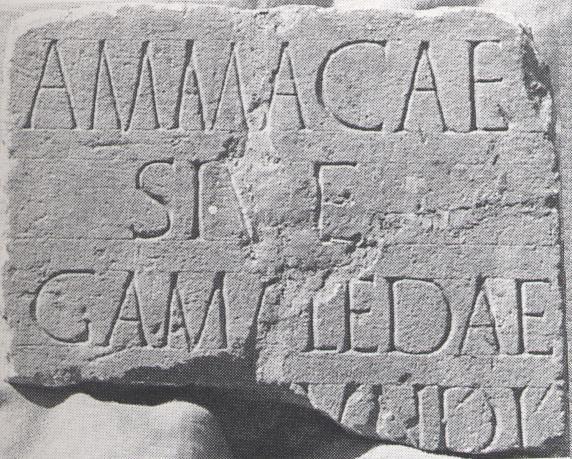
Celtic-Germanic tombstone
First one encounters medieval building remains and a wide draw-well, where the former St. Nicholas Panhuis pulled out his water. Besides lots of pottery is found some deer antlers.
Below the gardens in the Plankstraat one finds Roman building remains from the 1st century AD, and what is its most special, two carved stones.
The first is a tombstone that is reused in Roman times as a foundation for a new building. In this is chiseled: Ammacae sive Gamaledae (....)undi. Translated: to Ammaca or Gamaleda (? daughter of Verec ?)undus. Ammaca is a Celtic name, Gamaleda is Germanic. (1).
A unique find is the image of a gladiatorial combat. This concerns the outcome of the battle for the sword of gladiator right lies on the floor behind his right leg with trembling knee, he leans on his shield and he turns away. (2)
Possibly this concerns two female gladiators. The body structure and the position of the legs looks according to some female. It is in such a case in Europe the only find thereof. (3)
Both stones are used as foundation for buildings in the Roman castellum, for which they used old bricks and tombs. (4)
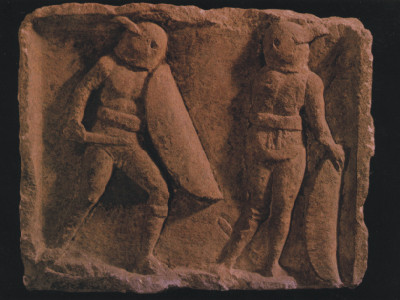
Gladiator fight
The historically very valuable and interesting gravestones are given to the city of Maastricht and make now part of the archaeological collection of the city.